
Motion Control in Packaging Lines: Synchronizing Axes, Machines and Products
A group of bottles moves towards the next stage of the packaging process. For the transfer to succeed, the bottles must arrive at the expected position, in the correct arrangement and at the exact moment when the machine’s handling mechanisms are ready to receive them. If any of these conditions changes, even individually precise movements can produce an incorrect result.
This is the industrial challenge addressed by motion control in packaging lines: coordinating movements so that the machine operates in harmony with the product, even when production speed changes.
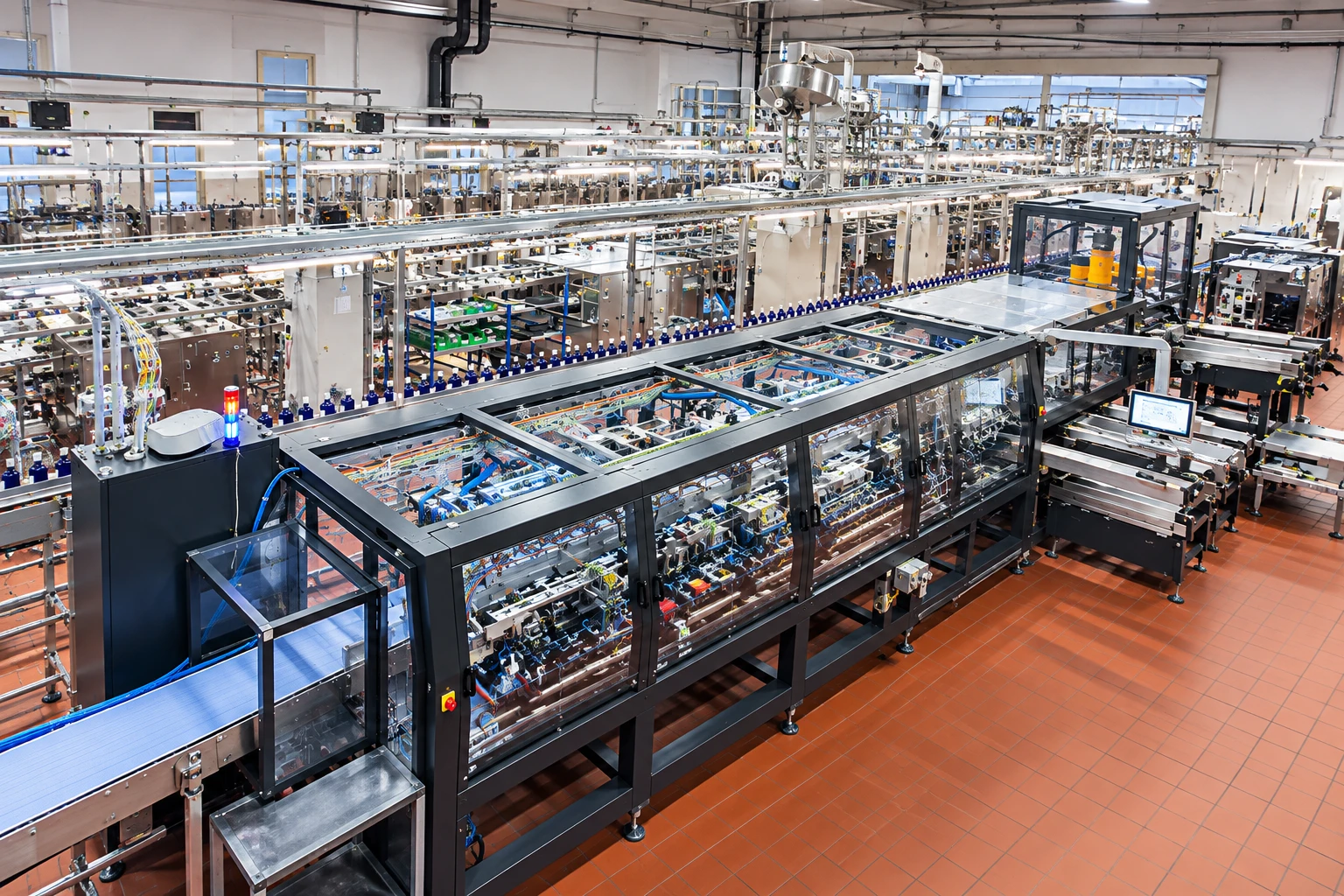
To understand how this works, we can look at the Cosmopack Cosmo-P W60-P, which combines functional rotary axes, two SCARA robots and dedicated format-change axes. Different technologies and movements must operate within the same production process.
A Common Reference: Machine Phase
The first question is straightforward: what determines when each axis must move?
In the engineering approach described by Cosmopack, the reference is a primary machine axis. Its angular position identifies the machine phase, meaning the point reached within the machine’s operating cycle.
We can imagine a cycle represented by one complete revolution, from 0 to 360 degrees. Different portions of the cycle correspond to specific operating conditions and the movements required to achieve them. This representation illustrates the operating principle without specifying the actual angular positions of the W60-P.
The other axes follow motion laws linked to this reference: some directly, others through an intermediate axis. Coordination therefore originates from a relationship between positions.
Synchronization means maintaining these positional relationships throughout the cycle. One axis may advance, another may slow down and a third may wait. Their behavior is correct when each axis reaches the required position at the appropriate machine phase.
Electronic Camming: Designing Motion Around the Product
An electronic cam defines how the position of an axis must change as the position of the primary reference changes.
It is the software-based evolution of mechanical cam technology: the motion profile is defined within the control system and executed through the drive system. Cosmopack has been using electronic camming in its machines for many years.
The advantage is the ability to adapt the motion law even after installation, through appropriately validated software modifications. This makes it possible to adjust axis behavior without replacing a mechanical cam, within the limits imposed by the machine’s structure and performance capabilities.
However, selecting the appropriate motion profile requires detailed knowledge of the product.
A bottle, for example, must be handled with acceleration and deceleration levels compatible with its stability and with its contact with the handling mechanisms. An excessively abrupt movement may mark the container or damage its label.
Production speed must therefore be achieved through movements that the product can safely withstand. This is where motion engineering meets application expertise: engineers must determine how much distance and time to allocate to each phase and how progressively the required speed should be reached or reduced.

Encoders and Servo Drives: From Commanded Motion to Actual Motion
Executing a movement requires feedback. An encoder measures the position of the component on which it is installed, often the motor shaft, and provides the feedback information used by the control system.
The servo drive regulates the motor to follow the required motion. By comparing the command with the feedback signal, the system can monitor the difference between the expected position and the measured position.
However, there is an essential distinction: knowing the motor position does not automatically mean knowing the actual condition of the product.
If a bottle falls or is missing from a group, the axes may continue to maintain their positional relationships correctly. The process therefore also requires dedicated sensors to verify the product’s condition.
Motion control and process monitoring provide complementary information: motion control governs machine movements, while process monitoring verifies the conditions required to perform operations correctly.
The Cosmo-P W60-P: Coordinating Main Machine Movements and Robots
The W60-P provides a practical example of this approach because it integrates three categories of motion:
- Functional rotary axes, responsible for the machine’s main movements.
- Two SCARA robots, whose movements are coordinated with the machine’s operation.
- Format-change axes with dedicated servo motors, designed to perform the adjustments required for different product formats.
These systems are complemented by sensors that monitor the product and its grouping, also referred to as collection, throughout the different operating stages.
The engineering challenge is to integrate these functions into a coherent sequence. Product availability and the operating status of the other machine mechanisms must be compatible with the operation to be performed.
In general terms, transferring a product between two handling mechanisms requires the receiving mechanism to be ready when the preceding mechanism releases the product. The time available to complete this operation must remain compatible with the machine cycle.
The presence of robots makes the importance of coordination particularly evident: their movements must fit into the overall process while respecting the operating conditions required by the other machine components.
What Happens When Production Speed Changes?
When a machine accelerates, its movements must continue to maintain the intended positional relationships between the axes.
With electronic camming, the position of the controlled axis is calculated as a function of the reference position. When the reference speed changes, the time available to execute the same motion profile also changes. This makes it possible to maintain phase synchronization, but the resulting speeds and accelerations must be verified.
A profile suitable for a particular production rate may become too demanding when executed more rapidly. Electronic cam design tools therefore allow engineers to analyze position, velocity, acceleration and the rate of change of acceleration, known as jerk.
Acceleration and deceleration ramps are consequently an integral part of machine design: they must respect both the capabilities of the drive systems and the behavior of the product.
Restarting the machine also requires careful consideration. When an axis must be re-engaged with its reference, the control system may provide a synchronization phase with defined dynamic limits. The actual sequence depends on the machine architecture and the type of stop: a normal production restart and recovery following a fault may require different procedures.
Sensors Verify That Products Meet the Required Conditions
In the approach described by Cosmopack, product monitoring systems can detect anomalies such as a missing or fallen item within a group. Depending on the devices installed, damaged products or weight-related anomalies may also be identified.
The choice of monitoring devices depends on the application and the types of defects that need to be detected.
These signals allow the machine control logic to manage anomalies according to the intended sequence, preventing an incorrect condition from being treated as a normal production cycle.
An incomplete product group clearly illustrates the problem: axis precision alone cannot make a package compliant if one of its products is missing. Motion control must be integrated with verification of the products being handled.
Between Machines: Synchronization and Product Flow Management
Within a single machine, precise positional relationships between axes may be required. Between consecutive machines connected by conveyors and accumulation systems, coordination often concerns product availability, receiving capacity and operating speed.
As Cosmopack explains, the simplest level of integration uses run and stop signals together with speed references. More advanced integration also coordinates acceleration and deceleration ramps and considers product accumulation levels upstream of machines and within intermediate buffers.
A buffer provides the line with a temporary margin to absorb differences in throughput.
If a machine stops briefly, products accumulated downstream may continue feeding the following stage, while available space upstream can accommodate incoming products.
When this margin decreases, the control system must adjust the speeds of the affected sections. After restarting, the machine that experienced the stop may temporarily increase its output to recover lost production, provided it has additional capacity and line conditions allow it.
Overspeed should therefore be understood as operation above the nominal line production rate, while remaining within the specified limits of the machine and product. If recovery is not possible or the buffers reach their limits, the affected sections must be slowed further or stopped in a coordinated manner.
This connects directly with the technical guide on OEE in packaging lines: actual production efficiency also depends on how the system absorbs and manages interruptions between successive stages.
Format Changeover: Returning to the Required Positions
Motion control also contributes to production flexibility during format changeovers.
In the W60-P, dedicated servo motors control the axes responsible for these adjustments. The operational advantage is the ability to reach the required positions accurately and repeatedly, reducing dependence on subsequent manual adjustments.
In the Cosmo-P W60-P, this technology makes it possible to complete a format changeover in less than four minutes, with the involvement of just one operator. This combines operational speed, adjustment accuracy and process repeatability.
When positioning values are managed through format recipes, recalling the parameters makes it possible to reproduce the required settings. This is a general principle of automatic format changeover systems; the extent of automated adjustments depends on the machine configuration.
The benefits concern both setup time and restart stability. However, the total duration of a format changeover still includes all necessary activities, including any component replacements and operator checks.
Diagnostics: Identifying the Source of an Anomaly
Cosmopack has introduced an advanced diagnostic system for motors and sensors, designed to identify and locate electrical and electronic anomalies detected within the machine.
For machine operators and maintenance personnel, the advantage is the ability to narrow down the area requiring intervention.
In a servo system, for example, an excessive difference between commanded and measured position may generate a following-error alarm. Drive manufacturers’ technical documentation shows that such an alarm may require checks on load conditions, mechanical obstructions or control parameters. The alarm helps guide the investigation but does not necessarily identify a single cause.
Associating an alarm with the relevant component and operating phase makes troubleshooting more targeted. When events are recorded and analyzed over time, they may also help identify recurring anomalies.
Designing Motion, Product Handling and Line Integration Together
The Cosmo-P W60-P demonstrates why motion control is a fundamental part of machine engineering: main movements, robots and adjustments must be coordinated while considering the actual conditions of the product.
The same principle extends to the complete packaging line, where speeds, buffers and restart sequences must support production continuity.
After exploring the flexibility of the COMBI platform and the measurement of efficiency through OEE, motion control provides a deeper understanding of the operating principles that make these results possible.
For Cosmopack, motion engineering means bringing together mechanics, control technology and product knowledge. The objective is consistent production, with movements compatible with the product and coordinated machine behavior under different operating conditions.
Want to Improve the Coordination of Your Packaging Line?
Let’s discuss your production requirements: motion synchronization, machine integration and format changeover management.
Related guides