
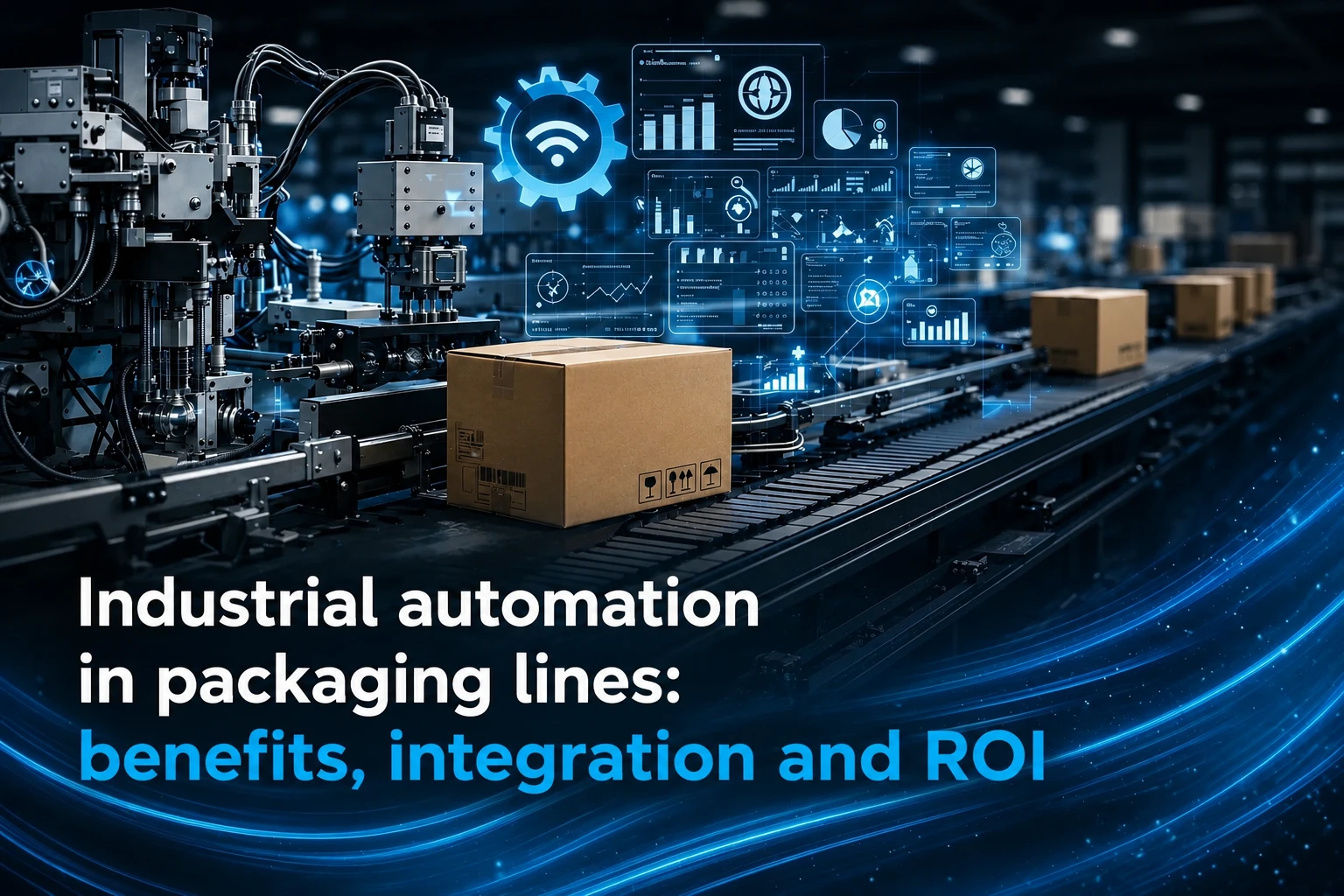
Industrial Packaging Automation: Benefits, Integration and ROI
Industrial packaging automation is no longer just a technological choice, but a strategic tool to improve efficiency, production continuity and competitiveness. Companies investing in integrated automated systems can reduce downtime, increase packaging quality and optimize the entire production process.
But what does automation really mean in industrial packaging? And what are the concrete benefits compared with traditional or non-integrated solutions?
What industrial packaging automation means
An automatic packaging line is a system made up of several machines and technologies working in synchronization: product handling, labeling, packaging and quality control are integrated into one continuous flow.
To better understand how these systems are structured, you can explore our complete packaging lines, designed to ensure full integration between all stages of the process.
The goal is not simply to automate individual operations, but to create a system capable of adapting to production volumes, reducing manual intervention and ensuring long-term stability.
Standalone machines vs integrated lines
Many companies start with standalone machines, gradually adding them to the production process. This approach can work at the beginning, but often creates inefficiencies over time.
- Lack of synchronization between stages
- Accumulation or slowdowns at critical points
- Greater need for manual intervention
- Limited scalability
An integrated line, on the other hand, is designed from the start to work as a single system, where every component is sized and coordinated according to the others, as in Cosmopack industrial automation solutions.
The benefits of industrial packaging automation
A well-designed automatic line provides concrete and measurable benefits:
- Reduced downtime thanks to continuous production flow
- Higher productivity with constant and predictable speeds
- Consistent packaging quality even during long production cycles
- Less operator dependency and fewer errors
- Optimized operating costs in the medium and long term
An important role is also played by industrial labeling machines, which ensure precision and continuity during product identification stages.
Integration: the real critical factor
The value of automation does not depend only on the machines used, but above all on the level of integration between the different modules of the line.
Product handling, labeling and packaging must be designed as parts of a single system, where speed, management logic and layout are perfectly aligned.
Industrial packaging machines must therefore communicate continuously with the rest of the line to avoid bottlenecks and production stops.
A non-integrated design can create inefficiencies even when using technologically advanced machines.
ROI and return on investment
Industrial packaging automation is often evaluated according to the initial investment, but the real parameter is long-term return.
The main factors influencing ROI include:
- Reduced labor costs
- Increased OEE, Overall Equipment Effectiveness
- Fewer rejects and rework operations
- Greater production capacity
OEE makes it possible to measure the real efficiency of a packaging line by combining availability, performance and quality. It can reveal production losses caused by downtime, micro-stops, reduced operating speeds and rejects that are not visible when considering nominal machine speed alone.
In many cases, a well-designed automatic line can shorten the payback period thanks to greater operational stability.
A process-oriented engineering approach
Every packaging line must be designed starting from the product, production volumes and performance goals. There is no single standard solution suitable for every company.
Process analysis is essential to define the most suitable configuration, layout and level of automation.
Conclusion
Industrial packaging automation is now one of the most effective tools for improving packaging line performance. However, the real competitive advantage comes from the ability to integrate technologies, processes and production logic into one coherent and efficient system.
If you are considering introducing or optimizing an automatic line, it is important to analyze the entire process and identify the solutions best suited to your production context.
Related guides
