
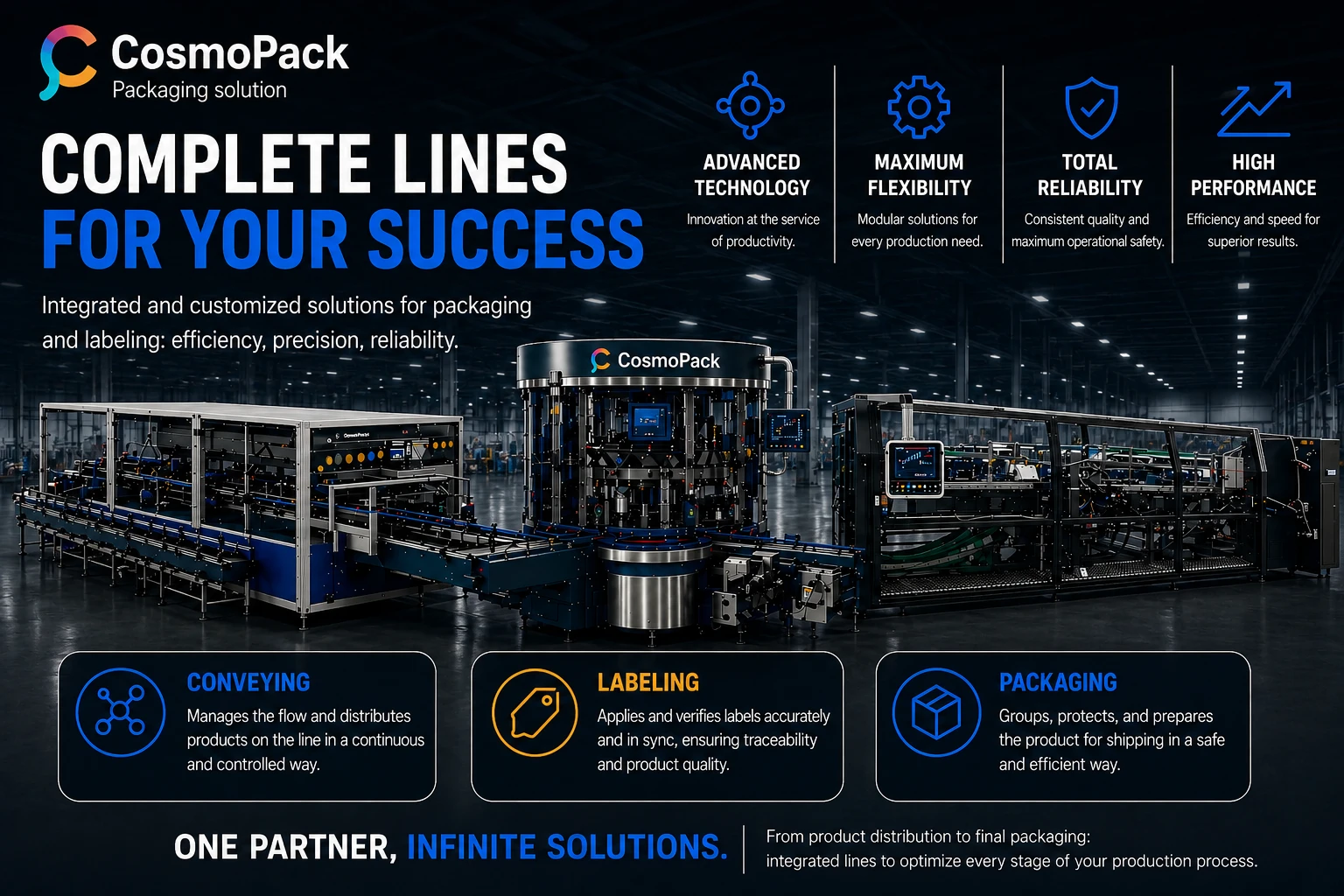
A modular packaging line is now one of the most efficient solutions for industrial automation, allowing companies to grow over time, reduce downtime and easily adapt to different products and production layouts.
A modular line consists of several integrated units, each designed for a specific function: feeding, product handling, packaging, labeling and final product management. Each module can be added, modified or replaced over time without redesigning the entire system.
Grow over time without redesigning your investment
One of the main advantages of a modular packaging line is the ability to evolve according to real production needs.
Many companies start with an initial configuration and later need to increase production capacity, introduce new formats or integrate additional processing stages. In a traditional system, this often requires major interventions across the entire production line.
With a modular solution, however, it is possible to add new modules, reorganize workflow or expand functionality while maintaining the original project structure. This protects the investment and enables more gradual and sustainable growth.
Reduce downtime and simplify maintenance
Another key aspect is production continuity. In a rigid system, a localized issue may affect the entire production flow. In a modular line, each section is easier to isolate, monitor and manage.
This means:
- easier technical intervention
- simplified and targeted maintenance
- reduced downtime
- greater overall line reliability
Reducing downtime directly improves line availability, one of the three factors used to calculate OEE in packaging lines. Monitoring availability together with performance and quality makes it possible to evaluate the real efficiency of the entire production system rather than considering only the nominal speed of individual machines.
Adapt to different products and layouts
A modular packaging line also offers significantly greater flexibility compared to traditional configurations.
Production requirements evolve: formats may change, products may vary, packaging requirements may differ or even the plant layout may be redesigned. A line developed with a modular approach makes it much easier to manage these changes without replacing the entire system.
- multiple product references
- frequent format changes
- products with different dimensions
- production layout evolution
Integrate new solutions into existing lines
Modularity is not limited to new installations. In many cases, existing systems can also be upgraded by integrating specific modules to improve workflow, increase automation or add new functionalities.
This makes it possible to improve performance without necessarily replacing the entire production line, offering clear advantages in terms of cost, timing and operational continuity.
Why modularity is increasingly important in industry
Industrial companies must face increasingly frequent changes: new products, different formats, higher productivity demands and continuously evolving production layouts.
In this context, a modular packaging line allows businesses to respond quickly without completely redesigning the production system.
Modularity enables targeted interventions by adding or modifying individual elements of the line according to actual production needs. This approach reduces costs, improves efficiency and increases operational continuity.
For this reason, more and more companies are choosing modular solutions to ensure a more flexible and long-lasting investment.
Conclusion
Choosing a modular solution means adopting a more flexible and reliable vision of industrial automation.
A modular packaging line allows companies to grow over time, reduce downtime and adapt more easily to changing production requirements.
Would you like to design a modular packaging line?
Contact Cosmopack for technical consultancy and discover the solution that best fits your production needs.
Related guides
