
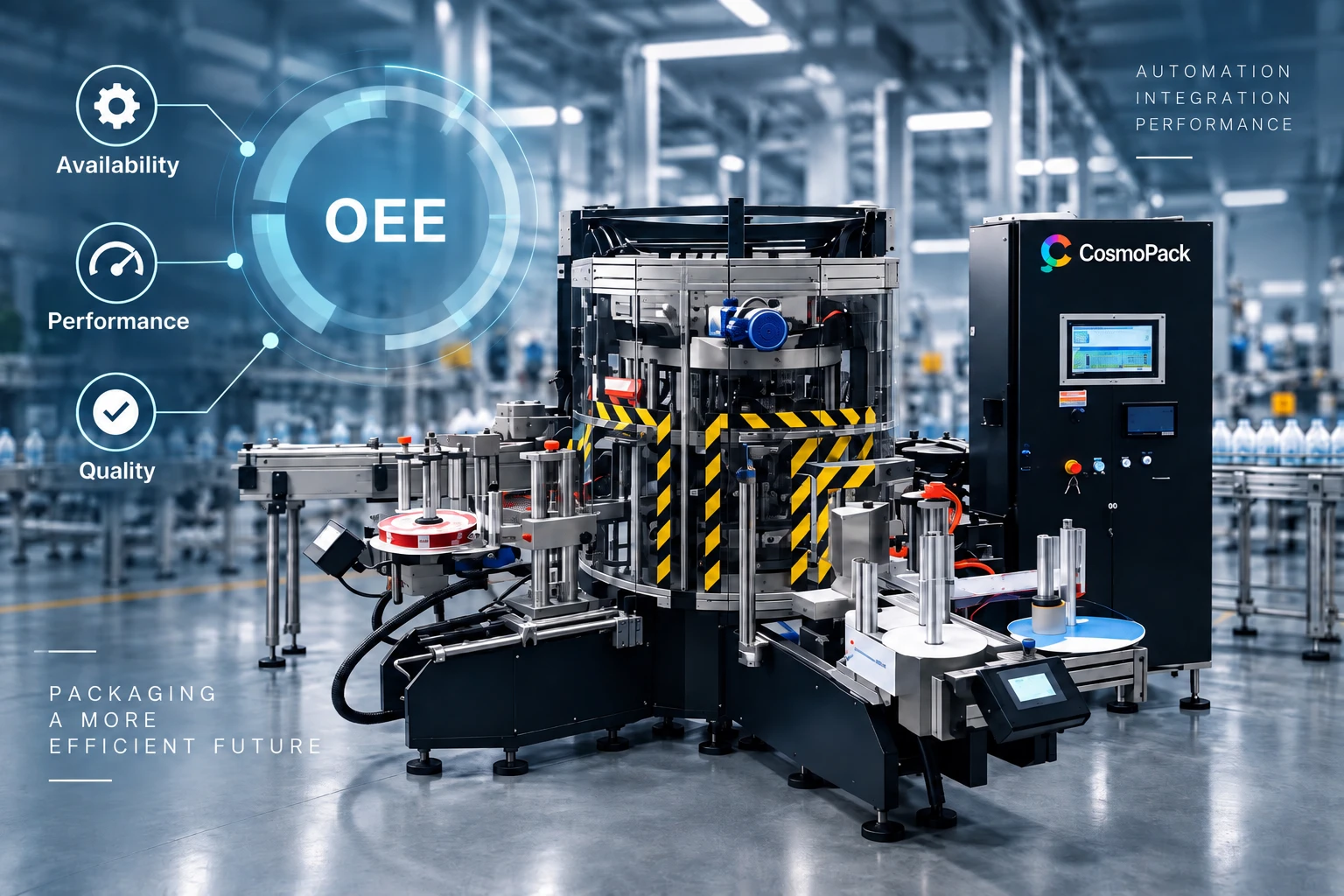
OEE in Packaging Lines: How to Measure Real Efficiency
A packaging line can consist of highly efficient machines and still produce much less than expected.
The reason is simple: the nominal speed of a machine does not necessarily correspond to the actual efficiency of the entire production process.
Downtime, micro-stops, slowdowns, feeding problems, incorrectly sized accumulation systems, format changes and rejects can significantly reduce the actual production capacity of a line.
To measure all these factors, the manufacturing industry uses a particularly important indicator: OEE, Overall Equipment Effectiveness.
What Is OEE?
OEE, which stands for Overall Equipment Effectiveness, is an indicator used to measure the actual efficiency of a production system or line.
Its value is determined by combining three fundamental factors:
OEE = Availability × Performance × Quality
Each of these elements represents a different source of production loss.
| Indicator | What It Measures | Examples of Losses |
|---|---|---|
| Availability | How long the line is actually operating | Downtime, failures, setup, format changes |
| Performance | How much the line produces compared with its theoretical capacity | Slowdowns, micro-stops, irregular product feeding |
| Quality | How much of the total production meets quality requirements | Rejects, non-conforming products, rework |
How Is OEE Calculated?
OEE calculation starts by measuring its three main components.
Availability
Availability compares the time during which the line was actually producing with the total time scheduled for production.
Availability = Operating Time / Planned Production Time
Performance
Performance compares the actual operating speed of the line with the speed it could theoretically achieve.
Performance = Actual Production / Theoretical Production
Quality
Quality measures the percentage of good products compared with total production.
Quality = Good Products / Total Products
An Example of OEE Calculation in a Packaging Line
Let’s consider a purely illustrative example.
A packaging line operates during a scheduled 8-hour shift, corresponding to 480 minutes.
During the shift, a total of 60 minutes of downtime occurs due to adjustments, format changes and minor interventions.
The actual operating time therefore becomes:
480 – 60 = 420 minutes
Availability will therefore be:
420 / 480 = 87.5%
Now suppose that the line can theoretically produce 100 packs per minute, but during the shift it operates at an average of 90 packs per minute.
Performance will therefore be:
90 / 100 = 90%
Finally, let’s assume that 98% of the products manufactured meet quality requirements.
The OEE value will be:
87.5% × 90% × 98% = approximately 77%
A line that may appear highly efficient on paper is therefore actually using only about 77% of its theoretical production potential.
Why the Speed of a Single Machine Does Not Tell the Whole Story
In an industrial packaging line, machines do not operate completely independently.
Each stage affects the next.
A packaging machine may be capable of operating at very high speeds, but this capability becomes of little value if products do not arrive consistently or if the downstream machine causes continuous slowdowns.
For this reason, actual efficiency must be assessed by considering the behaviour of the entire line.
Efficiency Is Determined Between Machines
In many production systems, the main efficiency losses do not necessarily originate from the most complex machine.
They can occur at the connection points between one stage and another:
- irregular product feeding;
- unstable product orientation;
- incorrectly sized conveyors;
- lack of adequate accumulation zones;
- insufficient synchronisation between machines;
- continuous stops and restarts;
- speed differences between the various stages of the line.
This is precisely why the design of product handling systems plays a fundamental role in the overall efficiency of a packaging line.
Micro-Stops: Small Losses That Become Significant
One of the most difficult phenomena to identify is that of micro-stops.
A stop lasting 10 or 20 seconds may seem insignificant.
But if the same event occurs dozens or hundreds of times during a production shift, the overall loss can become considerable.
There can be many causes:
- products arriving too close together;
- temporary lack of product;
- sensors detecting incorrect conditions;
- saturated accumulation systems;
- misalignments;
- frequent restarts of a downstream machine.
Analysing these events can often improve efficiency without modifying the main packaging machine.
Bottlenecks in Packaging Lines
Every line has a stage that determines the maximum capacity of the entire system.
This element is commonly referred to as a bottleneck.
The bottleneck does not necessarily correspond to the machine with the lowest nominal speed.
It may instead be a stage that creates instability in the product flow, continuous accumulation or repeated interruptions.
Correctly identifying the bottleneck makes it possible to understand where an intervention can generate the greatest increase in productivity.
Increasing the speed of the main packaging machine, in fact, does not always result in a real increase in the output of the line.
The Role of Buffers and Accumulation Systems
Accumulation systems make it possible to temporarily decouple two production stages, preventing a short interruption from immediately stopping the entire line.
A correctly designed buffer can therefore absorb small differences in speed and reduce the propagation of micro-stops.
The objective is not simply to accumulate products, but to manage the continuity of the production flow in a controlled manner.

Format Changes and OEE
Another factor that directly affects OEE is the time required to switch from one product or format to another.
During a format change, the line is not producing.
Reducing adjustment times therefore directly increases equipment availability.
Possible solutions may include:
- simplified adjustments;
- automatic positioning;
- stored production recipes;
- reduction of manual operations;
- components designed for rapid format changes.
Where Is Your Packaging Line Losing Efficiency?
The production limit is not always the main machine.
Analysing product feeding, handling, accumulation and synchronisation can reveal inefficiencies that are not immediately visible.
How to Improve OEE Without Replacing the Entire Line
A low OEE value does not necessarily mean that the entire production system needs to be replaced.
In many cases, it is possible to intervene on individual stages of the line.
Some examples include:
- optimising the product feeding system;
- improving product transportation and handling;
- introducing accumulation zones;
- automating a stage that is still manual;
- improving synchronisation between machines;
- reducing format change times;
- eliminating recurring micro-stops.
This approach makes it possible to focus the investment where it can generate the greatest production benefit.
From Machine Speed to Packaging Line Efficiency
When designing a packaging line, the most important question should not simply be:
“How fast is this machine?”
but rather:
“How much can the entire system produce consistently?”
OEE makes it possible to analyse the packaging line from this perspective.
Availability, performance and quality become concrete indicators for identifying losses, bottlenecks and opportunities for improvement.
In a modern packaging line, efficiency does not depend solely on the performance of individual machines, but above all on how effectively they work together.
Would You Like to Analyse the Critical Points of Your Packaging Line?
Micro-stops, feeding problems, accumulation issues, speed differences between machines and production stages that are still manual can reduce the overall efficiency of your system.
Cosmopack designs and integrates automation and product handling solutions to optimise production flow, focusing on the points that actually limit the performance of the line.
Cosmopack Insights
Related guides