
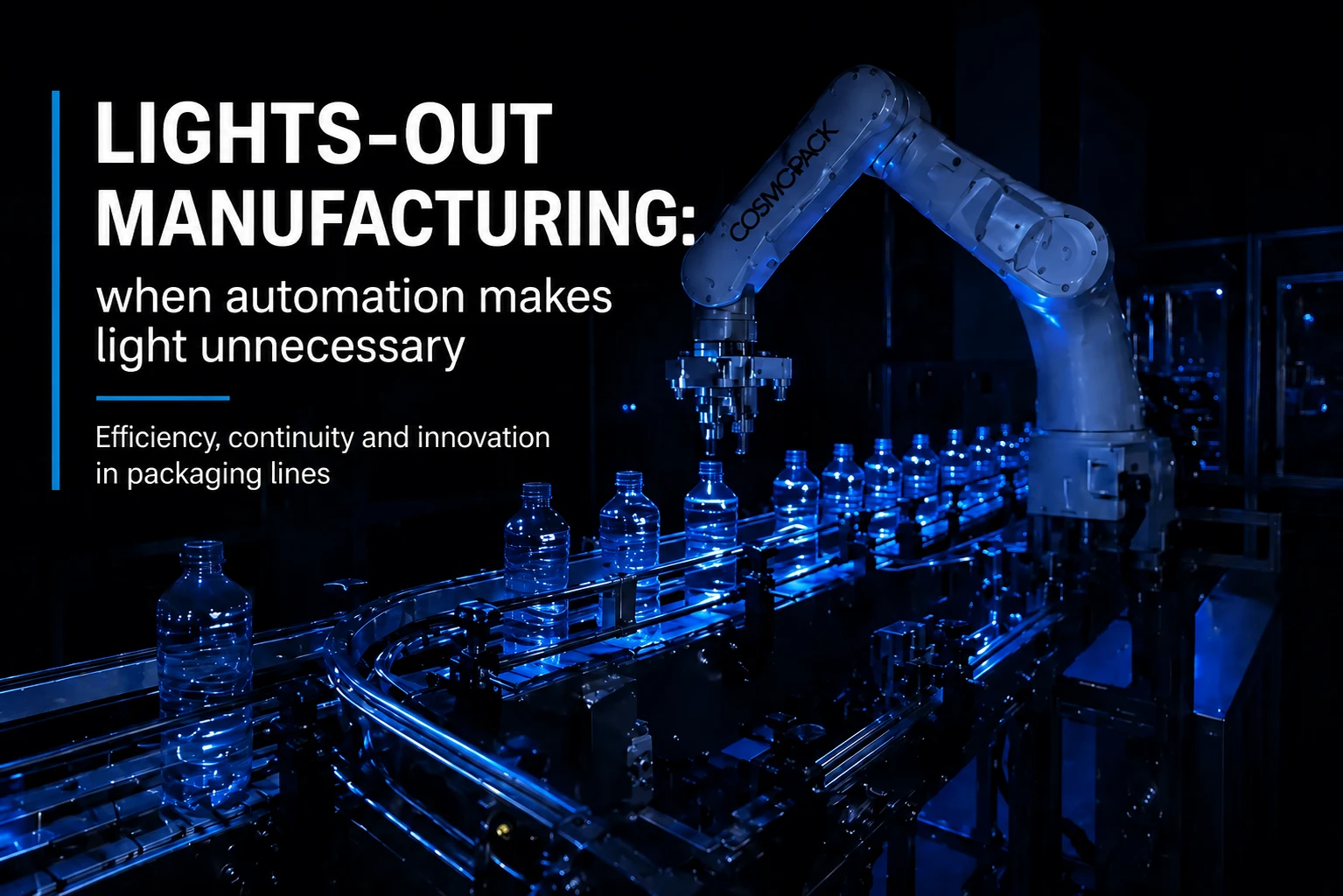
Lights Out Manufacturing: When Automation Makes Light Unnecessary
The evolution of industrial automation is making a new production model possible: automated lines capable of operating even in low-light or no-light conditions, improving energy efficiency, operational continuity and process control.
A new way of thinking about production environments
For decades, production environments were designed around one implicit assumption: the presence of human operators. Lighting, spaces, safety and workflows were structured to provide optimal working conditions for people.
Today, this paradigm is changing. The evolution of industrial automation is making possible a production model where continuous human presence is no longer required. This is where the concept of lights-out manufacturing, also known as a dark factory, takes shape: an approach driven not by futuristic ideas, but by a clear logic of efficiency.
If machines do not need light, why continue designing production systems as if lighting were essential?
Beyond automation: a shift in perspective
Reducing lights-out manufacturing to a simple application of robotics would be limiting. The real transformation is deeper and concerns how production lines are designed.
It is no longer about automating individual tasks, but about engineering integrated systems capable of independently managing:
- product flow
- synchronization between machines
- operational variations
- production continuity
In this context, lighting loses its functional role and becomes merely an accessory element.
The role of robots: invisible presence, continuous control
Industrial robots are among the most visible elements of this transformation, but they are not the only factor.
Their contribution is clear: operating with precision, repeatability and continuity, without depending on environmental conditions designed for people. However, it is the integration of sensors, vision systems and digital controls that truly eliminates the need for constant supervision.
The result is a production system that does not simply “work without light”, but no longer requires light to operate.
Energy efficiency: a consequence, not the only objective
Energy savings are often the first aspect associated with lights-out manufacturing, but they are neither the only nor necessarily the most important benefit.
Reducing lighting requirements, especially in large facilities, can significantly impact energy consumption. This is often combined with lower cooling requirements and more stable environmental management.
But the most relevant advantage is something else: operational continuity.
A production line that does not depend on continuous human presence can operate more consistently, reduce interruptions and maintain stable quality standards. Energy savings therefore become the consequence of a more efficient production system, not the sole motivation.
Packaging lines as the ideal environment
Among different industrial sectors, packaging lines represent one of the most suitable environments for applying lights-out manufacturing principles.
Many operations are already highly structured and repetitive:
- product handling and flow management
- high-precision labeling
- primary and secondary packaging
- coordination between multiple workstations
When these functions are effectively integrated, the production line becomes a continuous system capable of operating with an increasingly high level of autonomy.
In this sense, lights-out manufacturing is not a sudden revolution, but a natural evolution of already highly automated production systems.
Where dark factory concepts make sense
Not every production process is suitable for this model. Lights-out manufacturing works best in specific contexts:
- highly repetitive production lines
- standardized processes
- controlled environments
- high integration between machines
On the other hand, systems requiring constant human intervention or involving high variability may benefit less from this approach.
The real challenge is not simply “turning off the lights”, but understanding where and when it makes operational sense.
Towards a new concept of industrial facilities
Lights-out manufacturing should not be considered an objective at any cost, but rather an indicator of technological maturity. The more integrated, stable and autonomous a production line becomes, the less it depends on external factors originally designed for people.
In this scenario, automation is no longer just a tool to increase productivity. It becomes a central element in designing more efficient, sustainable and predictable industrial systems.
Cosmopack develops automation and line integration solutions that help companies move towards increasingly efficient production models, where operational continuity and energy optimization become an integral part of the project.
Would you like to design a more efficient production line?
Contact us to evaluate integrated automation, product handling, labeling and packaging solutions for your production process.
Related guides
